KDP's Free ISBN vs Buying Your Own
By SmartKDP
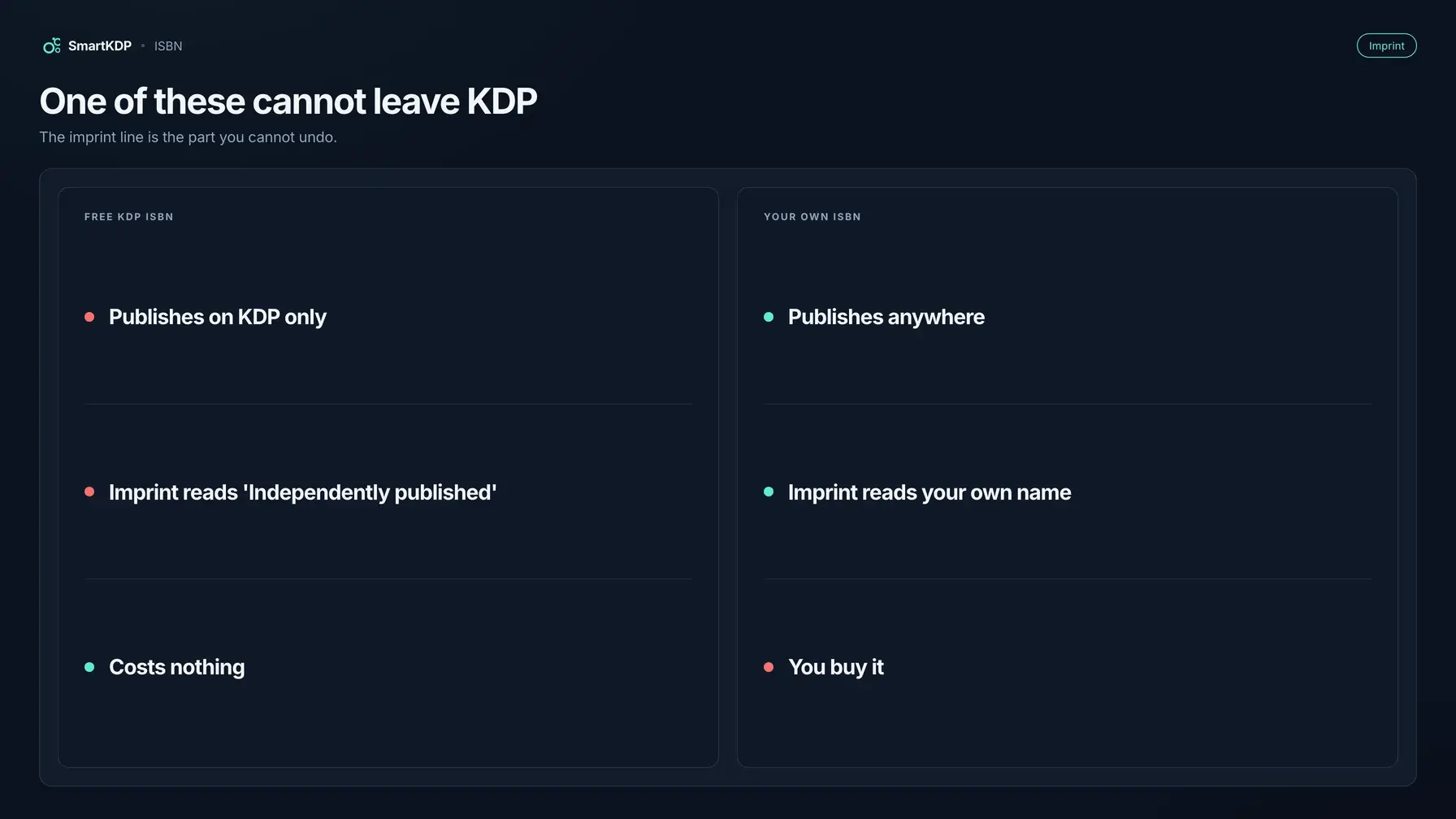
Amazon KDP will give you an ISBN for nothing. Most people take it, because at the moment you are asked the alternative costs money and the free option is already selected in spirit. The question is worth ten minutes anyway, because the choice attaches to that format of that book more or less permanently, and the thing it costs you does not show up until later — the day you decide to sell somewhere that is not Amazon.
This is the decision framed as what you give up, not as a recommendation. Both answers are correct for someone.
Not affiliated with Amazon. The rules below are quoted from KDP's own public help pages, which are linked in context. KDP revises its policies periodically — confirm anything you are about to act on against your KDP account and the current help docs.
What KDP actually gives you
Two facts from KDP's help pages settle most of this.
The free ISBN is print-only. KDP's ISBN help page states that free ISBNs "are only available for paperback and hardcover books". It also notes that ebooks and low-content books are the only formats where an ISBN is optional at all — a Kindle edition gets an ASIN and needs no ISBN, so this decision never applies to it.
The free ISBN cannot leave KDP. In KDP's own words: "Free ISBNs from us can only be used on KDP. They cannot be used to publish outside of KDP." That is the whole trade in one sentence. It is not a soft preference or a licensing nuance — the identifier is bound to the platform that issued it.
Your imprint becomes "Independently published". With a free KDP ISBN, the publisher-of-record metadata registers as Independently published, and you cannot change it. If you buy your own, KDP says it "will show the imprint name you enter to publish your book" — so a publisher name of your choosing is something the paid route buys and the free route does not.
One operational detail people hit at the worst moment: if you bring your own ISBN, KDP checks your entry against the record you registered with the agency. KDP states that "you won't be able to publish your book if there are any mismatches between this information." Register the title, author and format with your ISBN agency first, and match it exactly.
What the free ISBN actually costs you
Not money. Three specific options:
- Print distribution beyond KDP. IngramSpark, Draft2Digital print, a local printer for an event, a bookshop that orders through a wholesaler — none of them can use a KDP-issued ISBN. Going wide later means a new ISBN, which means a new edition record.
- Your own imprint on the record. If you intend to publish under a press name, the free ISBN forecloses it for that format.
- A clean, portable identity for the book. An ISBN you own follows the book across platforms and outlives your relationship with any one of them.
If none of those three will ever matter to you, the free ISBN is not a compromise — it is the right answer, and the money you would spend on an owned ISBN buys you nothing you will use.
The decision, in the order it actually resolves
Take the free KDP ISBN when the book is Amazon-only by design and likely to stay that way — most low-content and puzzle books, most first paperbacks, anything you are publishing to learn the process, and anything where the print edition is a companion to a Kindle edition that carries the real sales.
Buy your own when any of these is true: you already know you want IngramSpark or bookshop distribution; you are building a press identity across several titles; you are publishing someone else's work; or the book is a long-term asset you expect to still be selling in five years under conditions you cannot predict.
The honest middle case: you do not know yet. That is most people. The asymmetry is what should decide it — taking the free ISBN and later needing to go wide costs you a re-publish under a new identifier; buying your own and never going wide costs you the price of an ISBN and nothing else. Buying blocks rather than singles lowers the per-title cost substantially, so if you expect several books the arithmetic shifts further. (I am deliberately not quoting agency prices here — they vary by country and change; check your national agency directly.)
The barcode detail nobody mentions
Once you have an ISBN, it becomes a barcode on the back cover, and there is a specific and checkable trap in that step.
KDP reserves a 2 × 1.2 inch area on the back cover for the barcode. That is a keep-out zone, not a barcode size — a common and expensive misreading, because artwork built to fill the zone is at the wrong scale.
Here is what actually fits, computed from the EAN-13 specification:
| Artwork | Size at full scale | Fits the 2 × 1.2 in zone? |
|---|---|---|
| ISBN barcode alone | 1.47 × 1.02 in | Yes |
| ISBN barcode + 5-digit price add-on | 2.21 × 1.02 in | No — 0.21 in too wide |
The five-digit block to the right of the main barcode encodes a price. Add it at full size and the pair is wider than the space KDP reserved. Every tool I checked renders the add-on at nominal magnification without mentioning this.
Two ways out, and the first is usually right:
- Leave the price add-on off. It encodes a fixed price, and your list price is something you will change. A barcode asserting last year's price is worse than one asserting none.
- If you need it, reduce the magnification. At 90% the pair measures 1.99 × 0.92 in and fits — with almost no clearance, so check it against your actual cover rather than assuming.
The free ISBN Barcode Generator validates the check digit, converts ISBN-10 to ISBN-13, and renders the symbol at a magnification that fits the zone, with the add-on optional. Get the surrounding cover dimensions from the cover calculator first, since the barcode is placed relative to the back panel, not the whole wrap.
What you cannot undo
- The ISBN is bound to the format and edition. Changing it later is a new edition record, not an edit.
- A free KDP ISBN never becomes portable. There is no upgrade path; the replacement is a different number.
- Reviews and rank live on the listing. A new ISBN can mean a new detail page, and the social proof does not necessarily follow it.
- Your copyright page probably names the ISBN. If it changes, that page changes too — the copyright page generator will rebuild it, but the interior has to be re-uploaded.
None of that is catastrophic on a book with four sales. All of it is friction on a book that has found readers.
The short version
- Kindle editions need no ISBN. This decision is about print.
- A free KDP ISBN is genuinely free and genuinely cannot be used off KDP.
- Free means the record reads Independently published, permanently, for that format.
- If you might ever go wide, buy your own before you first publish — that is the only cheap moment.
- Bringing your own? Register it with your agency first and match the details exactly, or KDP will refuse the publish.
- Leave the price add-on off your barcode unless you have a specific reason, and check the artwork against the 2 × 1.2 inch zone rather than filling it.