How to Choose a KDP Trim Size
By SmartKDP
Most advice on this question stops at genre: novels get 5.5 × 8.5, nonfiction gets 6 × 9, activity books get 8.5 × 11. That is a fine way to build a shortlist and a bad way to make the decision, because it never mentions the thing that actually costs money.
Amazon KDP prints on two cost tables, and the boundary between them falls in a place that surprises people: immediately after 6" × 9". Of the sixteen standard trim sizes KDP offers, only five sit on the cheaper table. The other eleven — including several that look, on a shelf, indistinguishable from the ones that don't — cost more per page for the entire life of the book.
This guide is the decision in the order it actually binds: shortlist by genre, then eliminate by cost tier and page count, then check the interior survives the margins. It is written for the moment before you lay out, because trim is the one choice you cannot revise cheaply afterwards.
Not affiliated with Amazon. Everything below describes publicly documented KDP rules. KDP revises its cost tables and specifications periodically — confirm anything high-stakes against your KDP account and current help pages before you publish.
The cliff nobody mentions
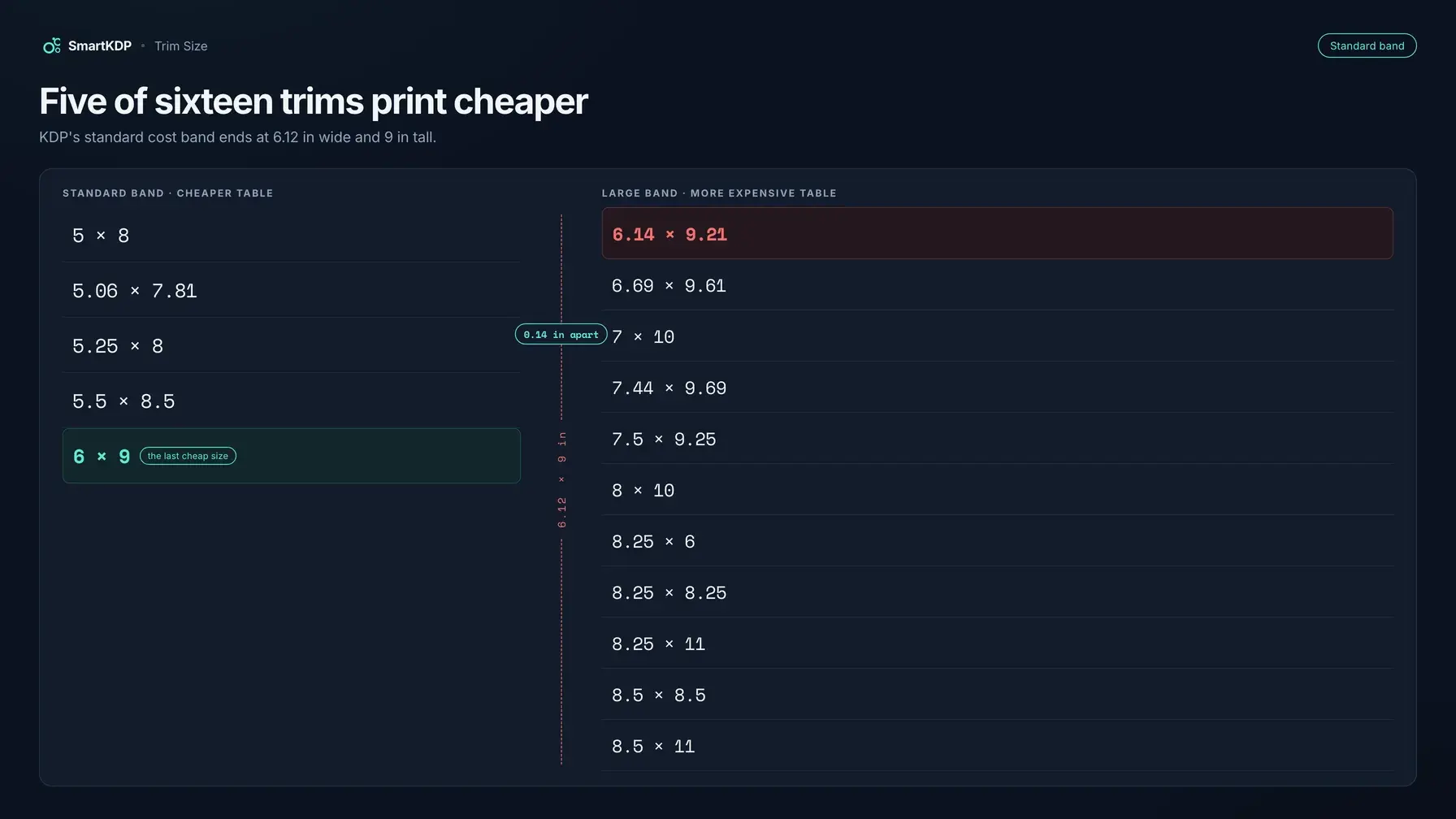
KDP's standard cost band ends at 6.12 inches wide and 9 inches tall. A trim inside those bounds prints on the cheaper table; anything past them, in either dimension, prints on the more expensive one.
Sort KDP's sixteen sizes by that rule and the split is lopsided:
| Band | Trim sizes |
|---|---|
| Standard (cheaper table) | 5 × 8, 5.06 × 7.81, 5.25 × 8, 5.5 × 8.5, 6 × 9 |
| Large (more expensive table) | 6.14 × 9.21, 6.69 × 9.61, 7 × 10, 7.44 × 9.69, 7.5 × 9.25, 8 × 10, 8.25 × 6, 8.25 × 8.25, 8.25 × 11, 8.5 × 8.5, 8.5 × 11 |
Two things follow that are worth sitting with.
6" × 9" is the last cheap size. It is also the most common trim in self-publishing, and now you know one reason why. Everything larger than it, however slightly, has crossed over.
The 0.14 inch between 6 × 9 and 6.14 × 9.21 is the most expensive fraction of an inch in self-publishing. Those two trims are visually near-identical — 6.14 × 9.21 is the metric-derived size (about 15.6 × 23.4 cm) common in academic publishing, and no reader will ever notice the difference. But 6 × 9 is standard-band and 6.14 × 9.21 is large-band, so the second one costs more per page than the first, on every copy, forever. If you picked 6.14 × 9.21 because it looked more "professional" in a template dropdown, you bought nothing and paid for it.
Because the premium is charged per page, its cost scales with the length of the book. On a short book the difference is loose change. On a long one it compounds into real money per copy, which is why the decision belongs before layout rather than after.
I am deliberately not printing the per-page rates here. KDP revises them, and a blog post quoting a 2026 rate in 2027 is worse than one that declines to. Run your own trim, page count, paper and marketplace through the free KDP Royalty Calculator — it holds the live constants and shows printing cost and royalty side by side, so you can price the same book at two trims and read the difference directly.
Step 1 — Shortlist by genre, but hold it loosely
Genre conventions exist because readers have expectations, and a book that looks wrong for its shelf is a real disadvantage. Use them to narrow to two or three candidates, not to pick one:
- Fiction, memoir, general trade — 5 × 8, 5.25 × 8, 5.5 × 8.5. All standard band.
- Nonfiction, business, self-help, technical — 6 × 9. Standard band, and the last one.
- Workbooks, journals, planners — 6 × 9 if it will hold the layout; 7 × 10, 8 × 10 or 8.5 × 11 when it genuinely will not.
- Children's picture books, activity and puzzle books — the large square and letter-ish sizes: 8 × 10, 8.25 × 8.25, 8.5 × 8.5, 8.5 × 11. These are large band without exception, and that is usually the correct trade rather than a mistake.
The useful discipline: when your shortlist contains one standard-band size and one large-band size, treat that as a real decision with a price attached, not a matter of taste.
For what each individual size is suited to, with its cover dimensions and costs at real page counts, see the trim size guide — every size has its own page.
Step 2 — Let page count break the tie
Trim and page count are not independent. A narrower trim fits fewer words per page, so the same manuscript is a longer book at 5 × 8 than at 6 × 9. And because printing cost is charged per page, a smaller trim can end up costing more per copy than a larger one on the same manuscript — the cheaper table applied to more pages.
That is the second thing the genre-only advice misses. The comparison you want is not "which trim is cheaper" but "what does this manuscript cost as a finished book at each candidate trim", which requires estimating page count at each one first.
Two shortcuts through that:
- Estimate the page count per candidate trim with the word count to page count calculator. It accounts for typeface, type size and how densely the book is set, and it reports a range rather than a false-precision single number, because the spread between a compactly set book and an airy one is genuinely large.
- Feed each resulting page count and trim into the royalty calculator above and compare the printed cost per copy.
Do that twice and the decision usually makes itself. It also surfaces the case where the "expensive" large trim is actually cheaper, which happens more often than people expect on long manuscripts.
Step 3 — Check the interior survives the margins
A trim size is not the width you get to lay out on. KDP requires an inside (gutter) margin that grows with page count, plus outside, top and bottom minimums. Your usable text block is the trim width minus the gutter minus the outside margin, and the gutter depends on a page count that the text block width helps determine.
For prose this is mostly self-correcting — narrower measure, more pages, slightly different band — and the margins and gutter guide walks through resolving that loop.
For anything fixed-width it is not self-correcting at all, and this is where trim decisions go wrong irreversibly. A puzzle grid, a table, a music stave, a wide code listing or a full-bleed illustration does not re-flow into a narrower text block. It gets scaled down, clipped, or it forces a redesign. If your interior contains fixed-width objects, work out the worst-case gutter for your target page count first, subtract it and the outside margin from each candidate trim width, and design to the width that survives.
That ordering — margins before grid, grid before trim confirmation — is the opposite of how most people do it, and it is why so many activity-book interiors get rebuilt.
Step 4 — Confirm the format you want actually exists
Not every trim supports every format. Hardcover is available on a much shorter list than paperback, so if a hardcover edition matters to you, that constraint belongs in step 1 rather than as a discovery in step 4. Each size's page in the trim size guide states which formats it supports.
What is actually irreversible
Trim can be changed after publishing, in the sense that KDP will let you upload a new interior. What that costs you is the part worth naming:
- The cover is sized to the trim and the page count together. Change either and the full wrap — spine width included — is wrong and has to be rebuilt. Get the dimensions from the cover calculator once the trim and page count are settled, not before.
- The interior re-flows, which moves every page break, every image placement, and the page count itself — which can move the gutter band, which moves the text block, which moves the page count again.
- Reviews and rank live on the listing, so authors are reasonably reluctant to disturb a live title.
None of that is catastrophic on a book with four sales. All of it is expensive on a book with four hundred. The decision is cheap now and dear later, which is the whole argument for spending twenty minutes on it.
The short version
- Shortlist two or three trims by genre convention.
- Check which side of the 6.12" × 9" boundary each one falls on. If your shortlist straddles it, that is a priced decision, not a preference.
- Estimate page count at each candidate, then compare real printing cost per copy — the smaller trim is not automatically cheaper.
- Subtract the gutter and outside margins and confirm your interior — especially anything fixed-width — still fits.
- Confirm the format you want is offered at that size.
- Only then build the cover.