What to Put on a Copyright Page
By SmartKDP
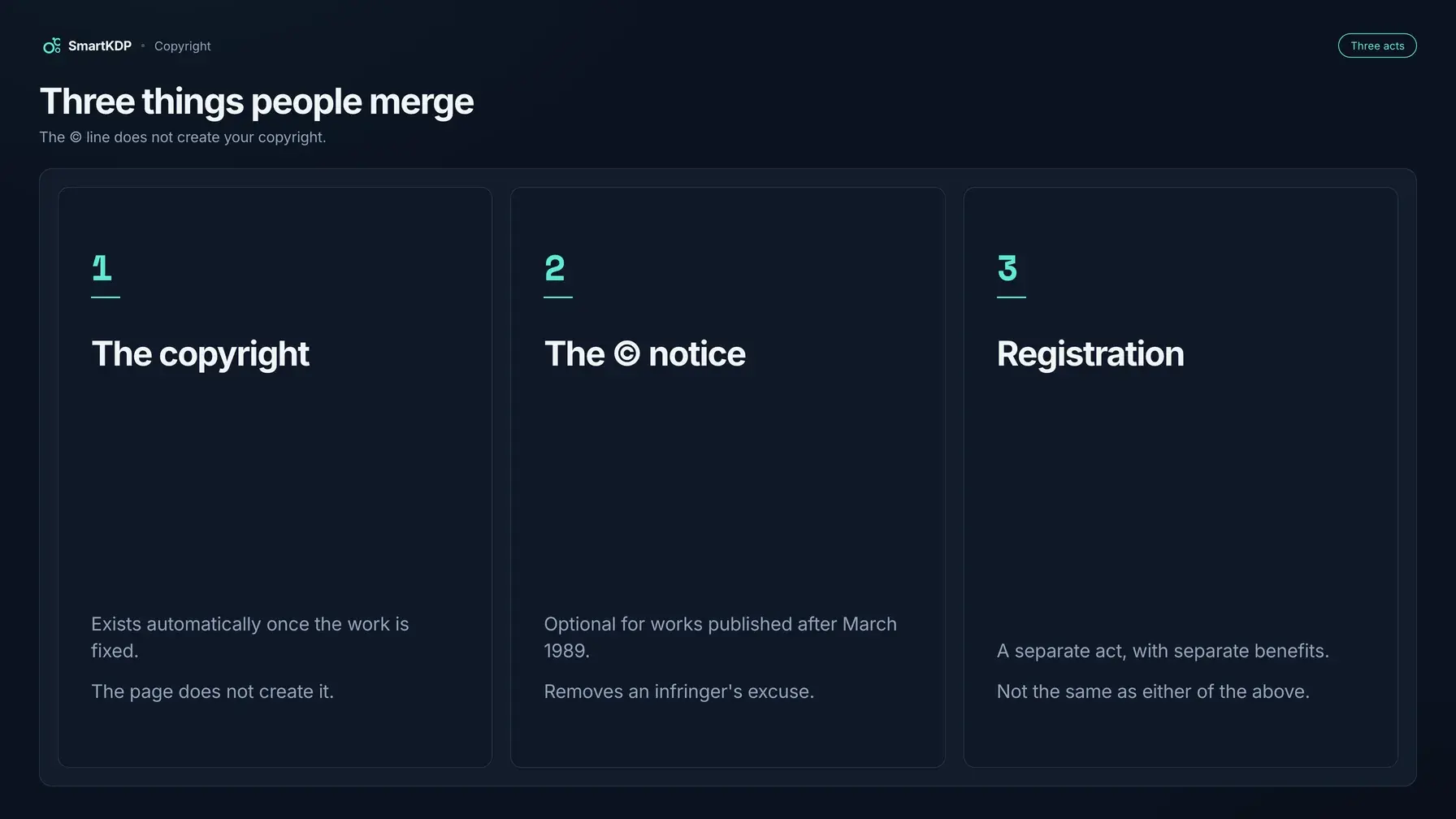
Almost every guide to this page treats the copyright notice as the thing that protects the book. It isn't, and the confusion matters: it leads authors to fuss over the wording of one line while skipping the step that actually determines whether they could enforce anything.
Three separate things get collapsed into one. Pulling them apart takes two minutes and makes the rest of the page obvious.
Not legal advice, and US-specific where noted. The statements below are drawn from the U.S. Copyright Office's own circulars, linked in place. Copyright law differs by country, and anything consequential deserves a lawyer rather than a blog post.
The three things people merge
1. The copyright exists already
From the Copyright Office's Copyright Basics (Circular 1): "Copyright protection in the United States exists automatically from the moment the original work of authorship is fixed."
Fixed means written down, saved, recorded. Your manuscript was protected before you opened a template. The copyright page does not create the right, and no wording on it can strengthen or weaken what you already own.
Worth noting from the same circular, because it catches self-publishers out: titles, names, short phrases and slogans are not protected by copyright. If you are worried about someone taking your title, copyright is the wrong instrument — that question lives in trademark, and the answer is usually different from what people hope.
2. The notice is optional — and still worth putting on
From Copyright Notice (Circular 3): notice "is no longer required under U.S. law" for works published after March 1989. The Berne Convention Implementation Act of 1988 made it optional.
So why include it? Because it does specific, narrow work:
- It defeats an innocent-infringement defence. An infringer who saw a notice cannot claim they did not know, and that claim, if believed, can reduce damages.
- It gives constructive notice to the public of the claim.
- It supports the owner's position on statutory damages and attorney's fees in litigation.
That is the honest case for the © line: not protection, but the removal of an excuse. It costs one line, so include it.
The three elements Circular 3 specifies:
- The symbol ©, the word Copyright, or the abbreviation Copr.
- The year of first publication
- The copyright owner's name
Copyright © 2026 Jane Doe satisfies all three. Elaborate wording adds nothing legally; it is a house-style choice.
3. Registration is the separate step, and the one with a deadline
This is the part the copyright-page genre almost never mentions, and it is the one with real consequences. Again Circular 1:
- Registration is not mandatory — but "before an infringement suit may be filed in court, registration (or refusal) is necessary for U.S. works." You cannot sue on an unregistered US work.
- "When registration is made prior to infringement or within three months after publication of a work, a copyright owner is eligible for statutory damages, attorneys' fees, and costs."
That three-month window is the actionable fact on this whole page. Registering later still permits a suit; it can cost you the categories of damages that make a suit worth bringing. Nothing you write on the copyright page substitutes for it.
What the page should actually contain
With the law separated from the formatting, the page itself is short.
Necessary in practice:
- The copyright notice — symbol, year, owner.
- A rights statement. "All rights reserved" is sufficient; a longer version simply spells out what that means for readers who will not look it up.
- The ISBN, with the format noted, since each format has its own. If you took KDP's free ISBN, the imprint registers as Independently published and you cannot change it — see KDP's free ISBN vs buying your own before you commit that line.
- The publisher or imprint name. Your own name is fine.
Usually worth adding:
- Edition and date, so a later revision is distinguishable from the first printing.
- A disclaimer suited to the book. Fiction takes the "any resemblance to actual persons" form; nonfiction that touches health, law or money takes a professional-advice disclaimer; an activity or puzzle book takes neither of those and may want a supervision note instead. A fiction disclaimer on a workbook signals a template nobody read.
- A contact or permissions line — where rights enquiries and bulk orders go.
- "Printed in [country]" for print editions. Not required, and meaningless in an ebook-only release.
Consider deliberately:
- A Creative Commons licence, if you actually want the book shared under defined terms. This is a real decision, not a formatting one: the licence variants differ on commercial use, derivative works and share-alike, and choosing one is choosing what strangers may do with your book without asking. "All rights reserved" and a CC licence are alternatives, not companions.
The order, and why it is the order
Put the notice first, the rights statement immediately after it, then the edition line, then the ISBNs, then imprint and contact, then any disclaimer.
The reasoning is simply that a reader scanning this page is looking for one of two things — who owns it, or which edition and ISBN this is — and both should be findable without reading the whole block. The disclaimer goes last because nobody arrives looking for it.
Our free Copyright Page Generator composes the page in that order, offers the rights statements and disclaimers above (including the Creative Commons variants and a puzzle/activity disclaimer), and exports to PDF or DOCX so it drops into the manuscript rather than being retyped. Every factual claim on that page names the Copyright Office circular or KDP help page it came from, with the date we last read it.
The short version
- Your copyright already exists. Fixation created it, not the page.
- The notice is optional post-1989 but cheap and useful — it removes the innocent-infringement excuse.
- Three elements: © / Copyright / Copr., year of first publication, owner's name.
- Registration is the separate step, is required before suing on a US work, and has a three-month post-publication window that governs statutory damages and fees.
- Titles are not copyrightable. That is a trademark question.
- Match the disclaimer to the book; a fiction disclaimer on a puzzle book is a tell.
- Decide Creative Commons deliberately or not at all.