How Much to Bid on Amazon Ads for a Book
By SmartKDP
Most advice about Amazon Ads for books explains what ACOS means and stops. That leaves the only question you actually have to answer — what number do I type into the bid box? — unanswered, and the guesses people fall back on are both wrong in the same direction: too high.
There are two formulas. Neither is complicated. Both are routinely skipped.
Not affiliated with Amazon. This describes arithmetic, not Amazon policy. Ad platform mechanics and reporting change; check anything time-sensitive against your own campaign data.
Why the usual mental model overshoots
ACOS is advertising cost of sale: ad spend ÷ sales revenue. Amazon computes it that way because Amazon's side of the transaction is revenue — the full list price.
Your side is not revenue. Your side is royalty, and the bid has to come out of that. On a print book, royalty is the royalty rate applied to list price minus the printing cost, and printing cost is charged per page. So the money you have to spend on advertising is meaningfully less than the list price, and less than the royalty rate implies.
This is where the common error lives. An author on a 60% royalty rate reasons that they can afford 60% ACOS. They cannot, because printing cost has already come out before they see a penny. Break-even sits wherever the royalty actually lands, which on a long book can be far below the headline rate.
Break-even ACOS = royalty per sale ÷ list price.
That is the whole first formula. Not the royalty rate — the royalty per sale, after printing, in the marketplace you are advertising in. If you do not know that number, you cannot set a bid, and every calculator that asks you to type your royalty in by hand is asking you for the figure most likely to be wrong.
Run your real trim, page count, ink and marketplace through the free Amazon Ads ACOS Calculator for KDP Books — it derives the royalty from KDP's own cost tables rather than asking you to supply it, then computes break-even from there. For the royalty on its own, the KDP Royalty Calculator runs the same maths.
The formula almost nobody states
Break-even ACOS tells you whether a campaign is profitable after the fact. It does not tell you what to bid, because a bid buys a click, and clicks are not sales.
The bridge is your conversion rate:
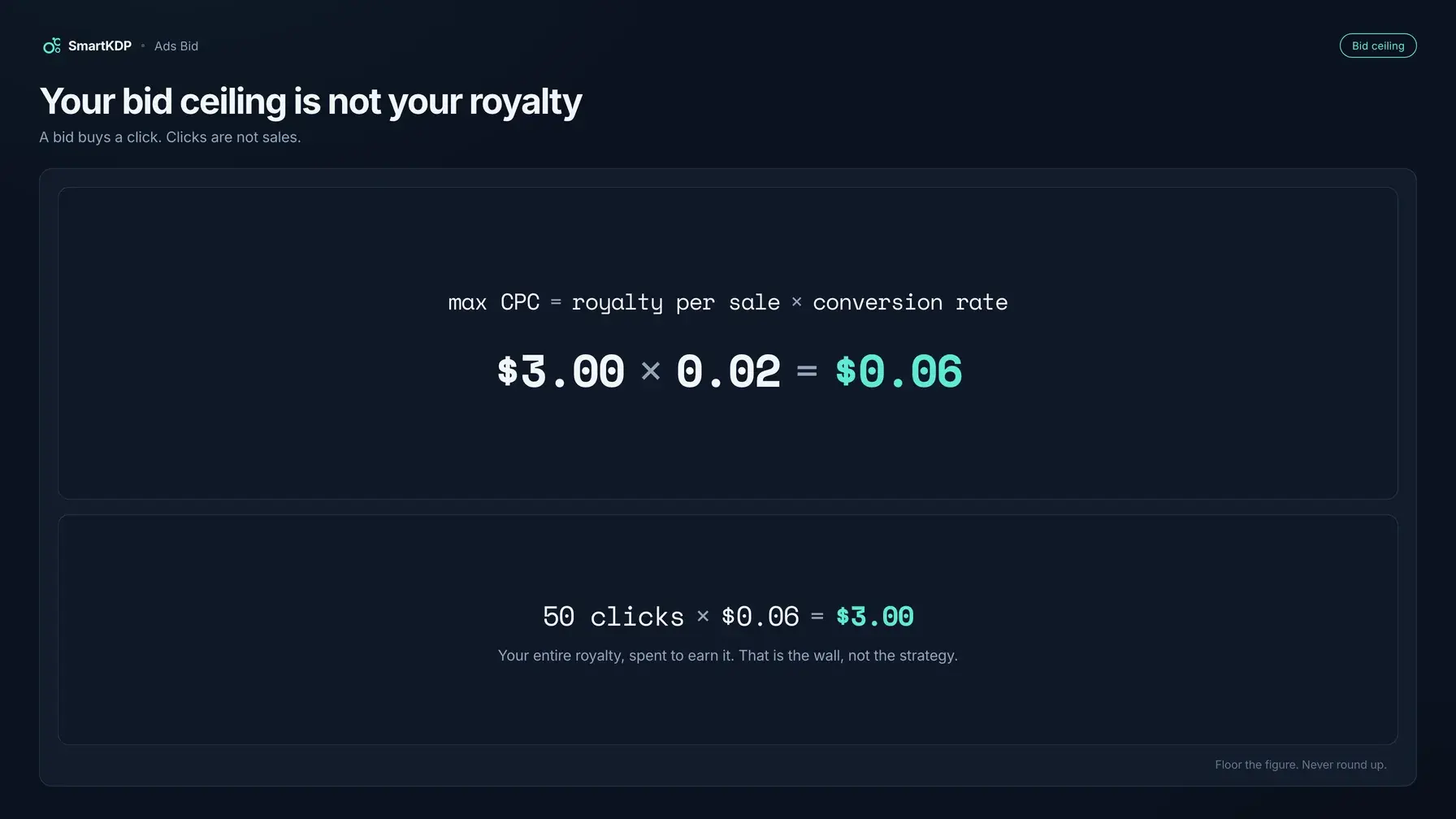
Maximum profitable CPC = royalty per sale × conversion rate
That is it. If you keep $3.00 a sale and one click in fifty buys, your ceiling is 3.00 × 0.02 = $0.06. Not sixty cents. Six.
The identity worth carrying is the sanity check on the other side of it: max CPC × clicks per sale ≈ royalty per sale. At a 2% conversion rate you need about 50 clicks per sale, and 50 × $0.06 is $3.00 — your entire royalty, spent to earn it. That is what break-even means, and it is why bidding at the ceiling is not a strategy. It is the wall.
To actually make money you bid below it:
Target CPC = target ACOS × list price × conversion rate
Pick a target ACOS under break-even, and this gives you the bid that lands there.
Round bids down, never up
A small thing with a real consequence: floor these figures, never round them.
Rounding $0.2952 up to $0.30 hands you a bid above your own break-even and labels it break-even. The error is under a cent per click and it points the wrong way every time, which over a campaign is exactly the kind of slow leak that makes ads feel unprofitable for reasons nobody can locate. Our calculator floors for this reason.
The same applies to conversion-rate optimism. Use the rate you have measured, not the one you hope for — the ceiling scales linearly with it, so a rate that is double reality gives you a bid ceiling that is double reality too.
What to do before you have a conversion rate
New campaigns have no conversion data, which makes the second formula unusable on day one. The way through is to treat the first period as measurement rather than performance:
- Work out break-even ACOS from your real royalty. If it is very low, the problem is the book's economics, not the campaign — a long book at a low list price may have no profitable bid at all, and no amount of targeting fixes that. Raising the list price or shortening the interior is the actual lever.
- Bid conservatively low and accept low volume. You are buying data, not sales.
- Once you have enough clicks to estimate a conversion rate, compute the ceiling and set a target beneath it.
- Re-check when anything underneath changes. Printing cost moves with page count; royalty moves with list price and marketplace. A bid that was profitable at 200 pages may not be at 320.
The check that decides whether to advertise at all
Before campaign structure, keywords or targeting, answer this:
At my current list price and page count, what do I actually keep per sale — and what is that number times my conversion rate?
If the answer is smaller than a plausible cost per click in your category, the book cannot be advertised profitably as priced. That is a pricing conclusion, not an advertising one, and the honest response is to fix the price or the page count first. The book pricing calculator shows how royalty moves across a price curve, which is where that decision gets made.
The short version
- Break-even ACOS = royalty ÷ list price. Not your royalty rate — printing cost comes out first.
- Bid ceiling = royalty × conversion rate. This is the number the field skips.
- Target CPC = target ACOS × list price × conversion rate.
- Sanity check: max CPC × clicks per sale should come back to your royalty.
- Floor every figure. Rounding up manufactures a bid above break-even.
- If the ceiling is below your category's realistic CPC, fix the price or the page count — not the campaign.